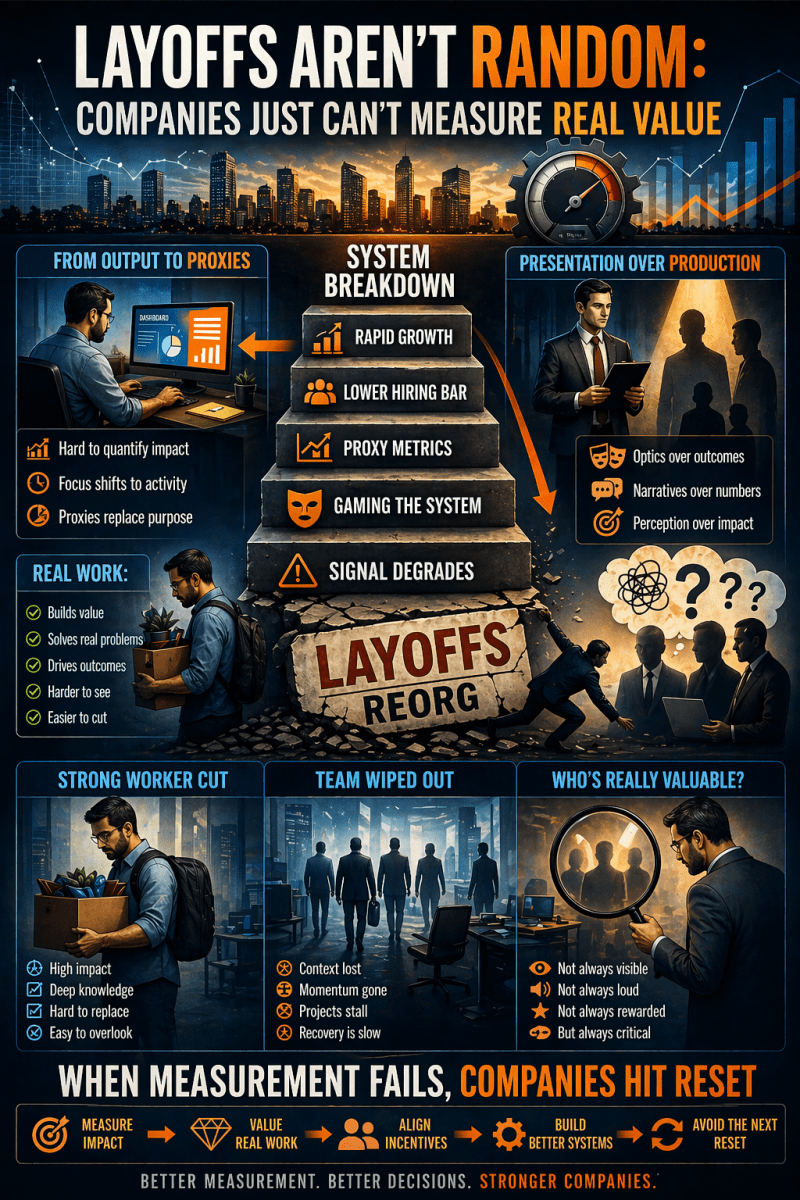
How performance systems break at scale—and why layoffs become blunt resets
I kept seeing layoffs happen and something didn’t add up. Strong engineers getting cut while others stayed, entire teams disappearing while others survived, and decisions that didn’t seem to match actual output. At first, it’s easy to blame macro stuff—overhiring, interest rates, bad leadership—but the more I looked at it, the more it felt like a measurement problem. Around the same time, I came across discussions about Stanford where a large percentage of students received academic accommodations, not necessarily because the population is fundamentally different, but because the system allows it and people adapt to it. That pattern felt familiar. Different environment, same underlying mechanism: when a system rewards something measurable, people optimize for that measurement.
The Core Shift: From Output to Proxies
When a team is small, you don’t need a system to tell who’s doing good work. You just know. Someone ships something important, fixes a production issue, or unblocks the team—everyone sees it. There’s no abstraction layer. But once a company scales, that breaks. Leadership can’t directly observe output anymore, so they introduce structure: performance reviews, peer feedback, ownership, documentation, visibility. All of that makes sense. The problem is that none of those things are the work itself—they’re signals about the work. And once you rely on signals instead of output, the system becomes gameable in ways that are hard to detect.
How the System Evolves (Step-by-Step)
What I’ve noticed is that this follows a pretty consistent pattern:
| Step | What Happens | Result |
|---|---|---|
| 1 | Companies compete and scale quickly | They hire aggressively to grow |
| 2 | Hiring bar drops to move faster | Talent quality becomes uneven |
| 3 | Org grows in size and complexity | Companies rely on proxies to measure work |
| 4 | Employees adapt to those proxies | People optimize for how work is measured |
| 5 | Signal starts degrading | Hard to tell who is actually high impact |
| 6 | Leadership needs to move faster again | Layoffs + reorgs as a reset |
Rational Behavior, Not Bad Behavior
Once the system is based on proxies, people adjust. This isn’t about people being dishonest—it’s just incentives. If your promotion depends on visibility, how your work is perceived, and how your manager evaluates you, then naturally you start optimizing for those things. You communicate more, frame your work more clearly, choose projects that are easier to show impact on, and align with the right people. These are all rational decisions. Individually, they work. But when enough people do it, the system starts measuring presentation instead of production.
Micro vs Macro Adjustments
I think of this as two layers: the work itself, and how the work is presented.
| Type | Behavior | Outcome |
|---|---|---|
| Macro |
|
Creates real value |
| Micro |
|
Improves survival in the system |
Micro adjustments are not wrong—you need some of them to survive. But if too many people rely on them, the system starts drifting away from actual output.
The Stanford Parallel
The Stanford situation is an extreme version of the same idea. Some discussions and reports suggest a much higher percentage of students received academic accommodations compared to other schools, and the more plausible explanation isn’t that the population is fundamentally different. It’s that the system is more permissive, and people respond to that.
What starts as a system meant to support those who truly need it becomes something people learn to optimize. And once enough people do it, not participating puts you at a disadvantage. That’s the key part: the behavior spreads not because everyone is trying to cheat, but because the system makes it rational.
When Signal Breaks
The same thing happens in companies. As more people optimize for visibility and perception, high-impact work and well-presented work start to look the same. Teams look busy, updates look strong, but it becomes harder to tie that back to real outcomes. Managers reward what they can see clearly, which is usually communication and visibility, not necessarily difficulty or importance. Over time, leadership loses the ability to tell what’s actually driving results.
Why Layoffs Become a Reset
At that point, the company has a problem: it can’t reliably identify who actually has high ROI. And figuring that out properly takes time that companies usually don’t have when they’re under pressure. So instead of being precise, they simplify. They cut headcount, remove layers, reorganize teams, and try to reset the system. Layoffs aren’t always about removing the worst performers—they’re about reducing complexity when the system itself has become too noisy to reason about.
The Part That Actually Matters
The issue isn’t that people game the system. That’s expected. The issue is that the system allows it at scale. Once enough people optimize for how work is measured instead of the work itself, the company loses its ability to measure real value cleanly.
By the time layoffs happen, the real problem has already been building for a while. The cuts are just the visible part. From the outside, it looks random. But inside the system, it’s what happens when measurement breaks.
And this isn't new. Systems have always drifted like this as they scale. What's different now is speed. AI didn't create the chaos. It just makes the cycle run faster. Hiring, scaling, signal degradation, and reset. All compressed.
So the real problem isn't whether layoffs are random. It's whether companies can measure real value at all.
References
A few pieces that shaped how I think about this:
- Why we will ALWAYS have tech layoffs no matter what — argues that layoffs are a recurring structural outcome of how tech companies scale, hire, and reset.
- Do 40% of Stanford Students Really Have a Disability? — discusses how permissive systems + incentives lead to optimization behavior.