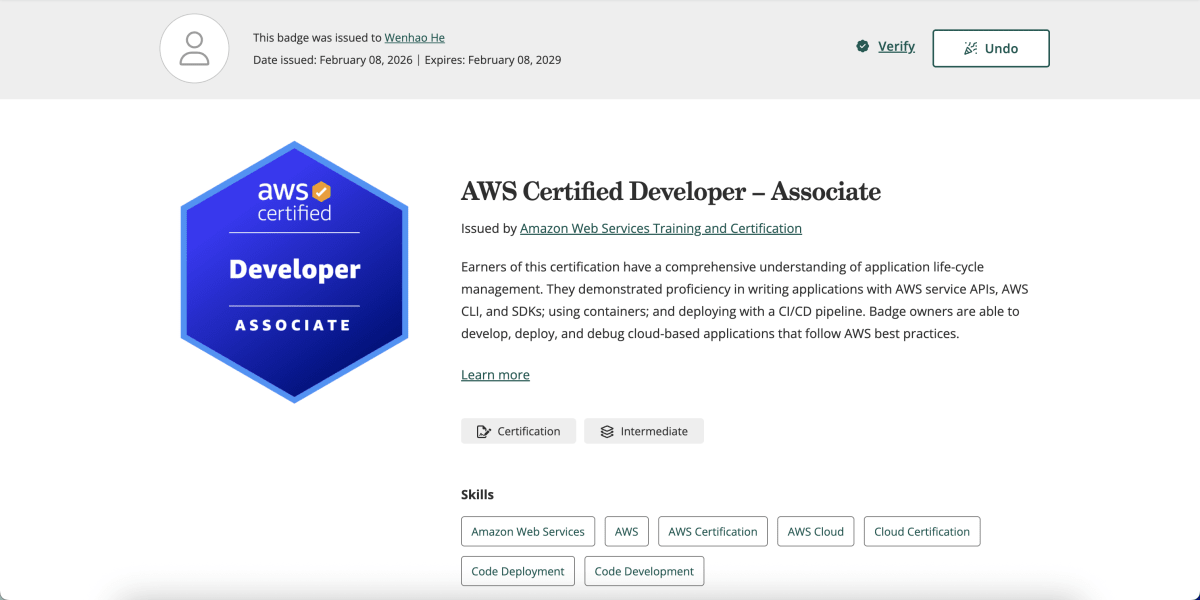
It’s 2026, and it’s been a while since I last published a blog post. Today feels like a good reason to break that silence. I’m happy to share that I’ve passed the AWS Certified Developer – Associate (DVA-C02) exam. This milestone reflects my hands-on experience building and deploying production systems on the cloud, as well as a focused effort to internalize AWS-native development patterns and real-world tradeoffs.
Why This Certification?
As a software engineer working on full-stack and AI-powered applications, cloud infrastructure is not an abstraction for me. It is part of my daily workflow. Across both professional work and personal projects, I have designed backend APIs, real-time systems, and serverless components that rely heavily on managed cloud services.
I am always eager to learn and improve. I pursued the AWS Developer Associate certification to formally validate this practical experience. My goal was not simply to recognize individual services, but to understand how they interact in real production environments, including security boundaries, deployment strategies, and failure behavior.
What the Exam Focuses On
The DVA-C02 exam emphasizes applied AWS knowledge rather than surface-level familiarity. The core focus areas include:
- Cloud-Native Application Development Designing event-driven and serverless systems using AWS SDKs, APIs, and the CLI. This includes services such as Lambda, DynamoDB, S3, API Gateway, SQS, and SNS.
- Security and Identity Design Implementing IAM roles and policies, Cognito authentication flows, KMS key policies, and enforcing least-privilege access with encryption at rest and in transit.
- Deployment and Automation Building CI and CD pipelines using CodeBuild, CodeDeploy, and CodePipeline, along with infrastructure as code using CloudFormation and SAM. This also includes understanding deployment strategies such as rolling, blue green, and immutable deployments.
- Observability and Optimization Monitoring and debugging applications with CloudWatch, X-Ray, and CloudTrail, and improving performance using caching layers such as ElastiCache and DynamoDB Accelerator.
How I Prepared
My preparation closely mirrored how I approach engineering work in practice. I focused on hands-on experimentation and understanding real system behavior rather than memorizing definitions. This meant designing serverless APIs, reasoning through IAM permission boundaries, handling throttling and scaling scenarios, and studying how AWS services behave under load and failure.
A key resource in my preparation was the Ultimate AWS Certified Developer Associate 2026 DVA-C02 course by Stephane Maarek on Udemy. The course helped me build a structured mental model of AWS services while reinforcing best practices through practical examples and architectural reasoning. I frequently paired the lessons with hands-on testing to validate how services actually behaved in realistic scenarios.
In addition to coursework and practice exams, I built my own reflex decision tree to systematize how I approached exam questions. This was not a single document, but a structured system designed for fast recognition and decision-making under time pressure.
I separated my notes into three distinct parts, each serving a different purpose during preparation. The reflex decision tree focused on identifying the correct architectural path based on the problem statement. Group A and Group B were maintained as separate pages that reinforced different types of knowledge.
Group A covered repeated and core rules. This page contained high-frequency concepts that appear across many questions, such as IAM evaluation order, default service behavior, security boundaries, scaling limits, and common AWS design patterns. These rules were meant to be instantly recognizable, requiring little to no conscious reasoning during the exam.
Group B focused on situational and one-off rules. This page captured edge cases, uncommon constraints, and easily overlooked scenarios that only apply in specific contexts. These rules were less frequent but often decisive, especially in questions designed to test deeper understanding rather than memorization.
The separation was intentional. The reflex decision tree guided how to think, while Group A and Group B reinforced what to recall, depending on whether the question tested a core pattern or a situational exception.
In the final days leading up to the exam, my review shifted almost entirely to these pages. Rather than revisiting long explanations, I repeatedly tested whether I could reach the correct decision within seconds by following the decision tree and recalling the appropriate rule set.
During the last 15 to 20 minutes before the exam, I reviewed only the reflex decision tree. This brief warm-up ensured that the decision flow was fresh in my mind, allowing me to maximize recall, minimize hesitation, and stay focused under time constraints.
Verified Badge
You can verify my AWS Certified Developer – Associate credential here:
View my AWS Certified Developer – Associate badge →
What’s Next
With a strong foundation in cloud-native development, my next goal is the AWS Certified Machine Learning Engineer – Associate (MLA-C01).
Given my background in artificial intelligence and experience building AI-powered systems, this certification aligns naturally with my trajectory. It bridges machine learning workflows with scalable, production-ready cloud infrastructure. I am particularly interested in deploying, monitoring, and operationalizing machine learning models on AWS at scale.
Ultimately, my focus remains the same. I aim to build reliable and performant systems that move from prototype to production, whether they are traditional backend services or machine learning driven applications.
I’ll be back with more regular blog updates going forward.
Stay tuned!